This is the organizational level in which we focus on bigger organizational units or whole organizations. We work on topics such as organizational alignment, cultures, context, structure, processes, vision, strategy and challenges. This is what we call the macro level. Topics that we address on the macro level:
Most of our programs can be tailored to take place remotely.
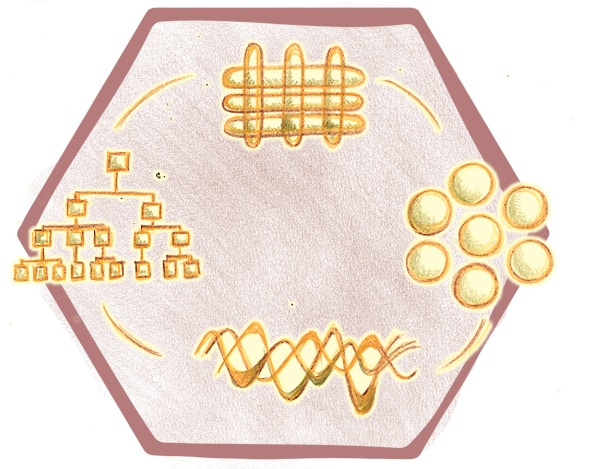
Organizational Development is a well-planned, holistic, systematic and structured change approach that fundamentally alters the way business is done. It is the outcome of shaping and aligning all the components of a company towards a clear vision or strategy.
OD involves creating a clear vision about the desired future look and feel of the company (the “to-be state”), assessing where it is now (the “as-is state”) and then determining how to close the gap between the two. The gap-closing activity is the Organizational Development.
OD generally focuses on increasing an organization’s readiness in coping with its present and future operating contexts and other business challenges, which are ever-changing. To accomplish this, OD measures address all the components and aspects of a company. Some of these are its systems, structures, processes, practices, culture, people and performance measurement.
As a company’s operating context is not static but constantly changing, OD needs to re-adjust itself and realign all its organizational components. So we speak about “Organizational Development Episodes”. What worked in yesterday’s episode may not work in today’s; what works in today’s episode may not be right for tomorrow’s. If the business results and the environment are signaling that the current design does not work, it is time to change it and start a new “Organizational Development Episode”.
We act as advisors and sparring partners to craft the best fit between an organization’s current and upcoming operating context and the “Organizational Development Episodes” ahead.
Organizational Episode-Based Leadership Development (OEBLD)
Organizational Episode-Based Leadership Development is our unique bridgingpositions steering approach for executive teams that need to create focus, stability, and alignment while the world refuses to stabilize. It breaks longer-term organizational development into clearly defined episodes, enabling executive teams to define the next organizational episode and align the organization around the priorities that matter most. In this way, OEBLD creates focus around what the organization needs most now and allows organizations to concentrate on what matters most in the current episode without losing the agility to adapt what comes next.
A culture change process starts by understanding the current culture with all its implicit details; it then designs the culture for the future organization and maps out the steps needed to implement the desired culture by using levers in both personal and leadership development and appropriate processes and structures.
Organizational Culture is made up of all the implicit, intangible aspects that determine how things are carried out inside the organization.
As it is the accumulated experience of the whole organization, it has a strong influence on its members and is difficult to change. Typical development directions of corporate cultures: Need to become more:
Agile
Innovative
Entrepreneurial
Customer-centred
Organized
Cost conscious
Collaborative, cooperative
Open and communicative
etc.
Overcome:
Compartmentalization, silo-thinking and acting
Putting personal wellbeing before organization wellbeing
Communication gaps
Talking behind people’s backs
Failure culture
Problem focus solution focus
etc
Organizational Backbone
This is about building a committed and mutually accountable executive management team, that is dedicated to lead the organization jointly into its greatest possible future while taking the entire organization along on this journey.
The Organizational Backbone Process generates peak alignment, orientation, focus and concentration of efforts in an organization. It is the premise for unleashing an organization’s full potential and creating the best possible joint results and effects throughout the organization.
Our Strategy Process develops shared strategic direction and turns it into coordinated action across teams. It makes priorities, contributions, and dependencies visible, and helps teams see what others contribute. Most strategy processes stop once priorities have been defined. Ours carries them into team-level contributions, critical dependencies, and concrete commitments. This is often the moment when teams see for the first time how their work connects to the work of others. That is how strategy stops being abstract and starts becoming executable across the organization.
Transforming companies to become agile and self-organized means changing the paradigm from seeing an organization as a machine to seeing it as a living organism. At the centre of this journey lies the transformation into a Purpose Driven organization: Why do we exist? What is our unique contribution?
A purpose is what propels the organization, its teams and employees and gives them direction and aligns their actions. This is what allows Self-Organization to work.
The increasing complexity of the business contexts favors Self-Organized groups. Speed, nimbleness and agility become crucial operating in a VUCA world. The transition in the corporate world is a continuous progression to becoming more open, fluid, adaptive, decentralized organization that empowers its own people while having at its core a strong shared organizational purpose. Teams work towards meeting their objectives with a more collaborative approach and take ownership of how they work and continuously evolve through having a continuous improvement mindset.
Co-Creation
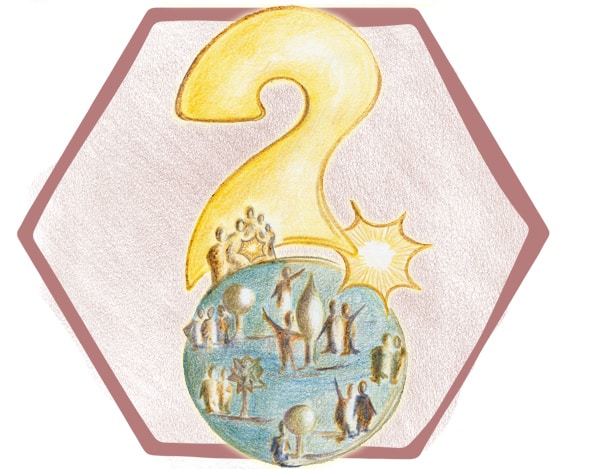
Co-creation is a choreographed process that brings the right people together to truly make progress on a complex challenge.
Co-creation as we see it is a designed journey undertaken by people, usually from different fields and backgrounds, who come together to find meaningful and sustainable answers to complex challenges and work out how to effectively implement them with the support of catalysts who co-design tailored-made events and facilitate the whole process.
Co-creation as an innovative practice relies on:
a well-designed structured process which achieves sustainable and tangible results and has a meaningful and effective impact on people
solid guidance, leading participants to enjoy a quality of relationship that allows them to engage in generative dialogues and achieve breakthrough
Innovation
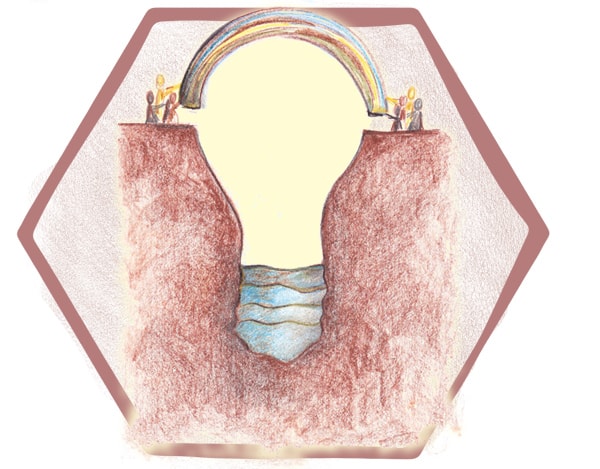
Innovation is at the heart of present and future economic success. We specifically have a look at:
How to set up tailor-made workshops for innovations
How to connect an organization to its innovation potential
In the field of innovation, we support organizations harvest their full innovative potential. Our innovation designs and formats allow both small and large groups to work on their specific areas of innovation. A creative co-creation process allows the group to access its collective intelligence and apply it in looking for a solution. In putting together the working group, we place special focus on the participants’ diverse, cross-functional backgrounds. This allows us to cover and apply a vast range of different perspectives, interests, ideas and know-how throughout the process. This diversity is the key to successful co-creation and innovation.
Our services cover two core areas:
Designing, developing and facilitating Innovation Workshops or Campuses
We are experts in providing stimulating settings that allow people to open up and share their ideas, challenges and know-how. This is the starting point for creativity and innovation
Bringing an organization and its culture into line with its best innovative potential
Helping an organization attune its culture to its greatest innovative potential means to: initiate, shape, and preserve a mindset of innovation within it. To obtain the intended shift in culture, an intelligent change process needs to be developed and implemented correspondingly.
Large Group Interventions (LGI)
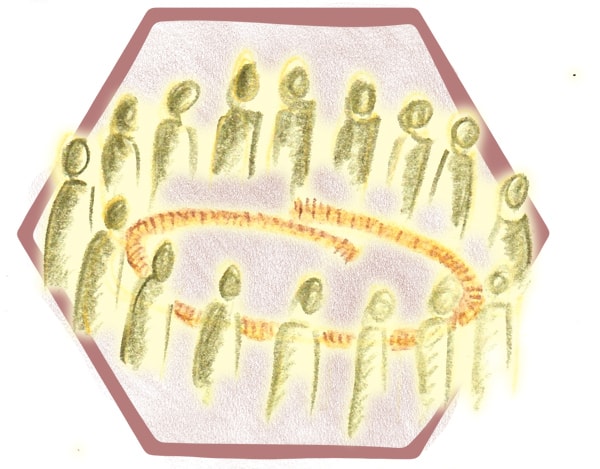
LGIs are essentially collaborative inquiries into present and future organizational topics (such as systems, practices, processes or visions), that are designed to co-create alignment around strategic directions and system-wide issues.
Large Group Interventions are multi-stakeholder interventions designed to “get the whole system in the room” in order to develop shared understandings and agreements. They are a participative, co-creative approach for organizational change that allows groups to use their creative potential to find solutions to their challenges. They thus build understanding, ownership, willingness and a capacity for change in the relevant organization or community. LGI is a carefully designed, prepared and methodically facilitated meeting or conference process, which normally lasts from one to three days. It allows an entire organization or community to work on resolving their complex challenges in a systematic way. These challenges can be as diverse as creating future direction, restructuring the organization, solving tough problems, or generating new, innovative ideas for products or services etc.
Different LGI methods share a focus on achieving sustainable changes and maintaining stakeholders’ active participation across the whole system. The number of people involved in LGIs varies from 30 up to 500+. An important design principle is to get the whole system into the room. This diversity of perspectives, opinions, and experiences, when guided and facilitated through a generative group dialogue process, is what leads to new creative, innovative and sustainable solutions.
Despite the fact that involving everyone in a large group process to resolving a complex collective challenge requires a huge initial investment of money and time, the savings in implementing the solutions are huge. This is because involving everyone in a large group process creates the buy-in and commitment that makes the implementation much more immediate and smooth.
We have designed and held LGIs with very different aims, including:
analysis of the current reality and context
building a collective vision, creating a clear picture and focusing collective energy on implementation
information and knowledge sharing to generate innovation
designing and implementing change roadmaps, creating buy-in, momentum and commitment for the change implementation
dealing with complex situations and challenges
tapping into the collective wisdom of the many to research organizational contexts and realities
building organizational alignment and focus
complex problem solving and searching for solutions collectively
etc.
Change Management
We see Change Management as a situational approach that supports the movement, alteration or transition of individuals, teams, or organizations from a current state to a desired future state.
Organizations undergoing or initiating change initiatives are often unaware of the positive effect that solid change management can have on reaching these goals.
So-called “people processes” focus on managing the internal dynamics of individuals, groups, teams or the organization that inevitably arise in a changing business environment.
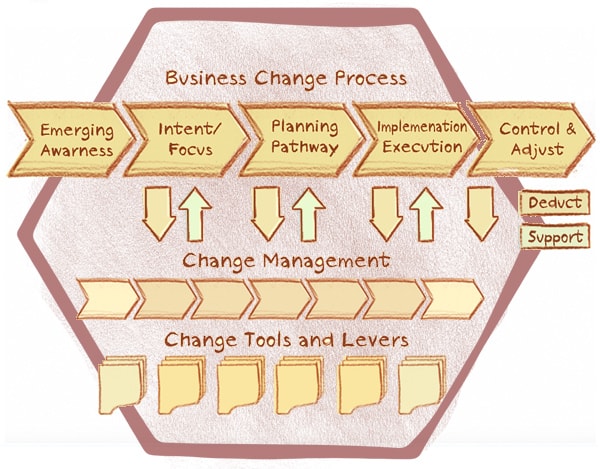
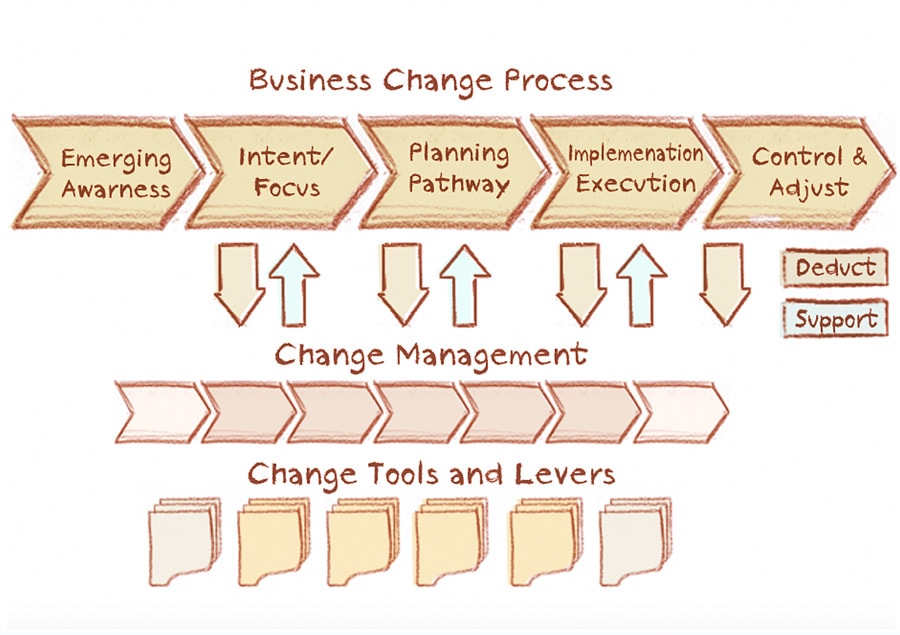
On an organizational level, Change Management is the term we give to all tasks, measures and actions that are designed and implemented to support profound, cross-functional, far-reaching, substantial changes related to organizations. We call these Business Change Processes.
The Change Management Process serves and pursues Business Change Processes.
What is a Business Change Process?
It is a Business Adjustment with a considerable impact on parts of or the entire organization. [PMI, Carve Out, Hard Restructuring, Reorganization, New Strategy and Organizational Alignment etc.]
What is a Change Management Process?
It serves, facilitates, safeguards, sets the frame and enables the implementation of the Business Processes. The Change Management Process is intimately connected to the Business Change Processes and is set up and designed to support and serve them. It is the sum of different interventions and measures that allow an organization to shift from its current reality to the intended future reality and, by doing so, consider the implications this has on an organizational, team or individual level.
Post Merger Integration (PMI)
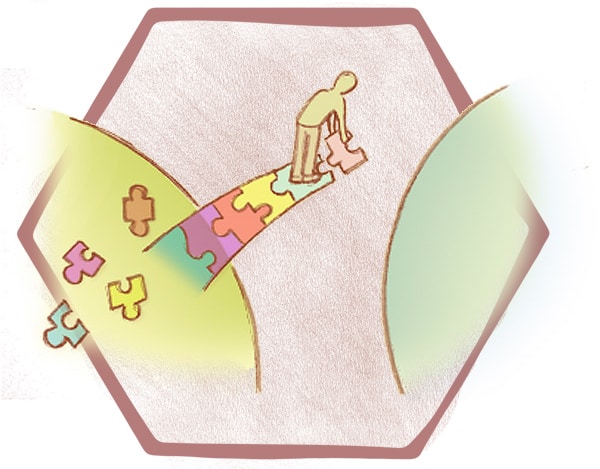
Understand the importance of the people side of an integration. Knowing how to set it up and manage it properly is considered the key premise for a successful PMI.
The integration needs to go beyond systems and processes. It should integrate the heads and hearts of the people affected.
After the acquisition of a business, the ‘Acquired Entity’ needs to be integrated into the existing businesses and structures of the ‘Buying Company’. This Post Merger Integration determines to a large extent if an acquisition becomes a success or not.
The success of a PMI depends on the active support of the key players on both sides. Winning their buy-in is a crucial executive and management task during the integration.
The profound changes that accompany a PMI naturally cause broad irritations, uncertainty and fears, which then easily lead to negative emotions, resistance, frustrations and conflicts. It is essential to focus on these emotions, which unfortunately are rarely considered, and often end up blocking the progress of change intents.
The best lever for success is making sure that people undergoing a PMI can process and cope with the changes on an individual, group and organizational level. This means allowing the organization, teams and people to explore and find ways with which to deal with the complexity, irritations, distress and pain that are part of an integration.
Carve Out
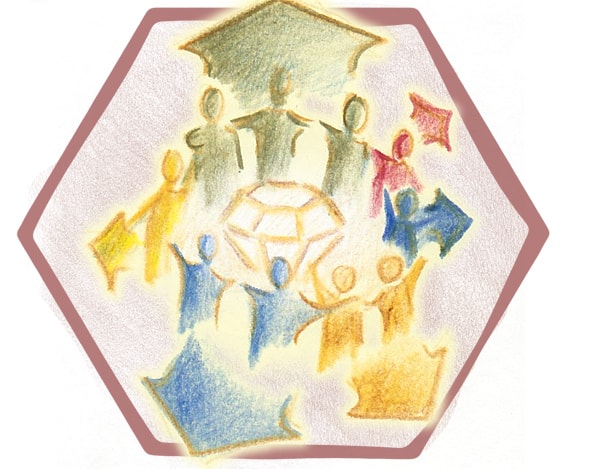
Preparing and managing a Carve Out (the divestment of a company or parts) is one of the greatest leadership challenges. We explore what to keep in mind and how to set it up from a Change perspective so that the people affected are not left behind.
A Carve Out is the disembodiment or selling of parts or businesses of a company. It has a profound impact on an organization, its groups, teams and individuals and is consequently one of the biggest challenges for the managers affected by it.
The following points are the main goals of Change Management in a Carve Out:
regaining and maintaining the trust of stakeholders (employees, business partners, management, customers, the public)
regaining and maintaining the capacity to act (individually, as teams, as an organization)
supporting managers in leading in times of transition
fostering order in an ambiguous, threatening and therefore stressful situation for the organization
fostering a proactive spirit of optimism in the relevant organization
changing views on the situation from a feeling of being a victim or of losing perspective to a mindset that is open and focused on opportunities
giving the affected managers and employees a voice in the carve out negotiations
driving future success for individuals, teams and the organization
A carve out is more than an extended and complex project. Special focus has to be put on the organizational, team and individual processing of the current and future situation. The management has to be prepared for dealing with the powerful emotions that come along with a carve out.
Restructuring Implementation Framework
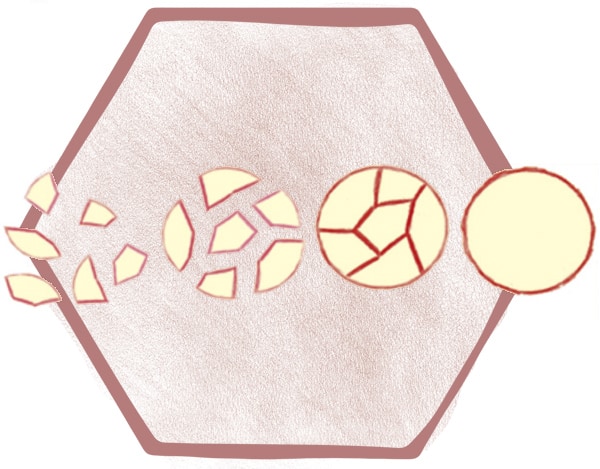
Restructuring is one of the most critical leadership situations an organization can face. It puts the whole system under strain at once: uncertainty rises, trust comes under pressure, and resistance becomes more likely precisely when leadership needs to provide direction and steadiness. The b+p Restructuring Approach helps leaders guide the organization through this transition — from the old world into the new.
The following two workshop formats are specifically designed to overcome two crucial challenges that naturally arise in Post Merger Integration and Carve Out situations.
Nature Reserves
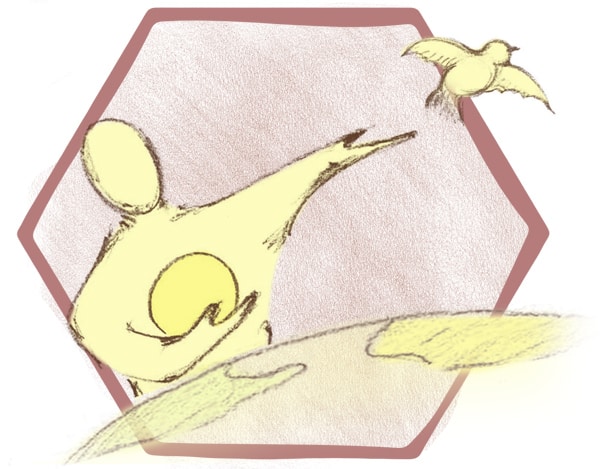
The Nature Reserve concept is about understanding and capitalizing the deep underlying implicit, tacit organizational success factors which often become destroyed in the course of an integration or restructuring.
The Nature Reserve concept is designed for situations where organizations, departments or teams are dissolved, integrated or reorganized. Often, people are laid off or together with their tasks transferred to other organizational entities. The main goal of the Nature Reserve concept is to detect, define and make available the often hidden successes of the old organization to the new one. Especially during mergers and acquisitions, there is a considerable danger of destroying the purchased value by implementing new standards, procedures and processes without examining their potential negative impact on the acquired unit or team. What and where are “Nature Reserves” and how can we prevent them from being lost or destroyed by the integration?
The Nature Reserve Workshop focuses on value capture, to preserve the strengths and values both of the Buying organizations and the Bought ones, in the creation of the newly joined business.
Managing Transition
In most severe change processes, leaders face the issue that their organizations, teams and employees are more difficult to lead than before.
This programme is designed to support leaders in this leadership challenge.
Whenever there are major changes in organizations, Managing Transition becomes highly relevant. For example during a Carve Out, a Post Merger Integration or a Hard Restructuring there is usually a long period of uncertainty in organizations. In this transition period it is only clear that drastic changes are ahead but neither the employees nor the middle managers know what they will face in the future to come. Especially for the middle management, this is a very difficult time. Their people, as well as they themselves, experience deep insecurity about their future, along with the corresponding unpleasant emotions (uncertainty, fear, aggression, inner dismissal, loss of identity etc.). In these circumstances, managers nevertheless need to lead and operate, not knowing how this will affect them, their unit, team or employees. Managing Transition is all about supporting managers in dealing with this tremendous leadership challenge, for which they are in general not prepared.
What is the programme designed for?
This pain and turmoil of transition is the starting point for a number of Transition Dynamics that leaders need to cope with. Managing Transition is about managing these dynamics. We help executives to manage the transition period between announcement and the completion of the integration in order to:
minimize impact on productivity, safety and day-to-day business
facilitate a smooth, seamless integration for all stakeholders
support managers to handle the effects and the consequences of transition
equip leaders to communicate face-to-face with employees about the tough choices required to drive growth in the future
tailor actions to the needs of each unit or team (in collaboration with management and HR for example)
build acceptance for change and help improve retention
At this level, we focus on personal growth, and enable people to develop the necessary skills and attitudes to successfully deal with themselves, their situations and the challenges they face.
At this level, we focus on improving the quality of relationships, communication, cooperation and interaction, both inside and between groups and teams.
To provide the best experiences, we use technologies like cookies to store and/or access device information. Consenting to these technologies will allow us to process data such as browsing behavior or unique IDs on this site. Not consenting or withdrawing consent, may adversely affect certain features and functions.
Functional
Always active
The technical storage or access is strictly necessary for the legitimate purpose of enabling the use of a specific service explicitly requested by the subscriber or user, or for the sole purpose of carrying out the transmission of a communication over an electronic communications network.
Preferences
The technical storage or access is necessary for the legitimate purpose of storing preferences that are not requested by the subscriber or user.
Statistics
The technical storage or access that is used exclusively for statistical purposes.The technical storage or access that is used exclusively for anonymous statistical purposes. Without a subpoena, voluntary compliance on the part of your Internet Service Provider, or additional records from a third party, information stored or retrieved for this purpose alone cannot usually be used to identify you.
Marketing
The technical storage or access is required to create user profiles to send advertising, or to track the user on a website or across several websites for similar marketing purposes.

 Organizational Development
 Organizational Episode-Based Leadership Development (OEBLD)
 Organizational Culture
 Organizational Backbone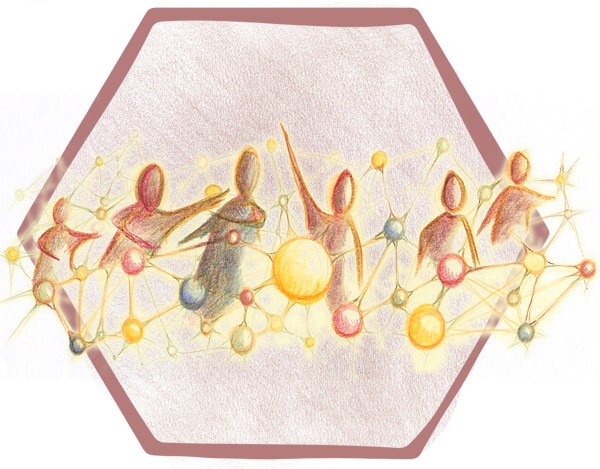
 Co-Creation
 Innovation
 Large Group Interventions (LGI)
 Change Management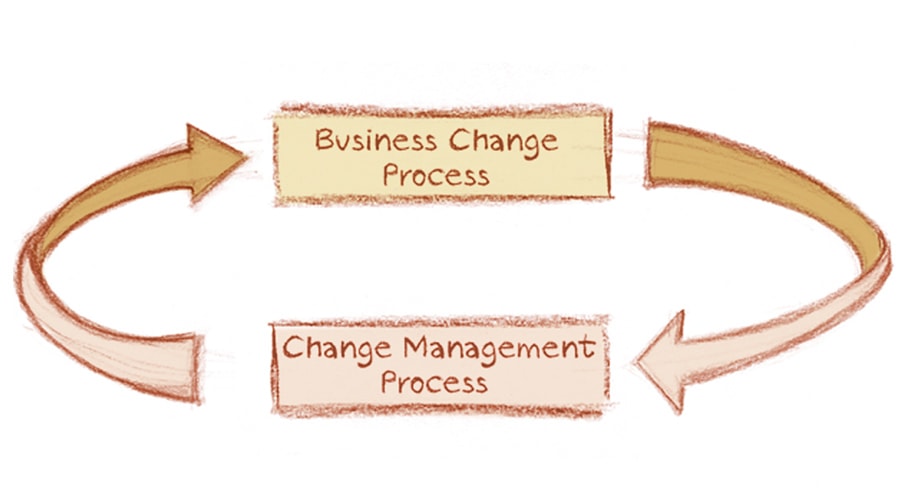
 Post Merger Integration (PMI)
 Carve Out
 Restructuring Implementation Framework
 Nature Reserves
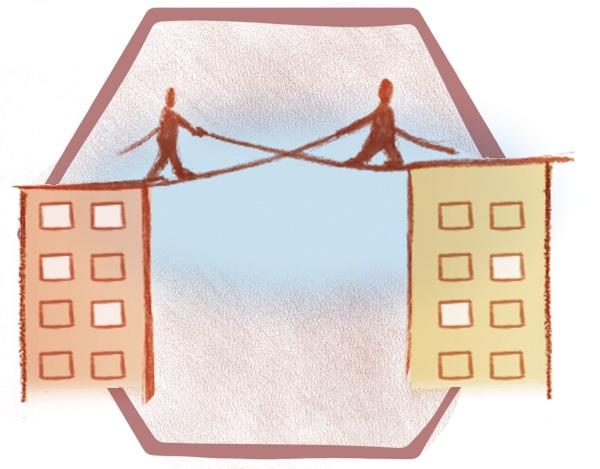 Managing Transition